Training Modules
This training resource aims to support researchers, students, and research and development professionals working in Artificial Intelligence (AI) and data-driven technologies (DDT) to meaningfully engage with, learn from, and collaborate with the communities impacted by their work. This is essential to designing and delivering research, products, and services that are ethical, effective, and inclusive. While community engagement and co-production are well established in humanities and social science research, and in public service design and delivery, these practices are relatively new in AI/DDT. Drawing on research and practice from across disciplines and sectors and designed in response to the unique context of AI/DDT, we offer the following training resource as an invitation and a guide to fostering an ethos and practice grounded in social justice, equity, and care.
PEAs in Pods: Co-production of community-basedpublic engagement for data and AI research.
This training was created as part of the PEAs in Pods:Co-production of community-based public engagement for data and AI research project.
PEAs in Pods is one of five flagship projects in the UK funded by the Engineering and Physical Sciences Research Council (EPSRC) (Grant Ref: EP/W033488/1) to build capacity and capability for public engagement with research in information and communication technologies. Running from September 2022 to May 2025, the project is led by Professor Keeley Crockett, Manchester Metropolitan University, and delivered in partnership with Noisy Cricket: a social enterprise bringing impacted people together with organisations across sectors to co-create transformational new social possibilities.
The project aimed to empower the Greater Manchester (GM) data science and artificial intelligence research communities to engage meaningfully with traditionally marginalised communities and embed co-production methods into individual and institutional research processes and governance. It involved training a cohort of data scientists and AI researchers, known as Public Engagement Ambassadors (PEAs), from three GM universities, and supporting and mentoring them to work confidently with co-researchers from three community groups through a series of Public Engagement Programmes.
How to use this resource
This resource aims to support students, researchers, and research and development professionals in the following:
- Cultivating an ethos and understandings that support ethical, effective community engagement and co-production
- Engaging with key theories, concepts, and issues relating to community engagement and co-production and the AI and data-driven technology research and development sector
- Experimenting with different tools, activities, and practices
- Exploring the possibilities and challenges of community engagement and co-production throughout the research process
- Developing and deepening reflexive practice
- Contextualising community engagement and co-production within wider institutions and sectors
- Accessing additional information and resources
There are myriad ways of ‘doing’ community engagement and co-production, shaped by different communities, disciplines, questions, and contexts. While we offer opportunities to engage with some of these ‘doings’, this resource is as much an introduction to an ethos as a practice. Throughout the activities there is an overarching focus on reflexive practice, learning by doing, embracing diverse ways of knowing and being, and attending to relationality and the role of power. Where possible, activities are designed to model this ethos and provide embodied, affective, and critical opportunities to put it into practice.
This resource was originally developed and delivered as part of the PEAs in Pods: Co-production of community-based public engagement for data and AI research project. While we have made minor adjustments to the materials to make them more broadly relevant and accessible, they nonetheless reflect the context and approach of that project. They may therefore require further adaptation to suit other participants. It is important to note that this resource was produced for an English-speaking audience and in the UK context. It may need adapting for other linguistic, national and international contexts.
This resource is not a replacement for in-person mentorship and training. Nor can it replicate the dynamic, messy, unexpected, challenging, and joyous realities of practically engaging with communities. We hope, however, that it offers a range of critical insights, prompts for reflection, and practical skills that can help prepare students, researchers, and research and development professionals to embark on a journey towards a more equitable, inclusive, and socially just ethos and practice.
This resource is designed to be delivered with groups of people. It is organised into four approximately half-day modules, beginning with foundational concepts and topics and then moving through the research process, exploring approaches to, and possibilities and challenges of community engagement and co-production at each stage. This structure reflects the mode of delivery in the PEAs in Pods project. However, all training materials are self-contained and can be reorganised to suit the needs, interests and schedules of participants. We encourage facilitators to ensure that time is built into the schedule for ‘hanging out’, with refreshments provided if possible. This is a key aspect of community engagement and co-production, supporting informal learning and community building.
We have endeavoured to provide all the information you need to deliver this training. Each activity includes a downloadable PDF Activity Sheet outlining the following:
- Duration
- Aims
- Requirements (e.g. equipment, space)
- Activities
- Resources (provided as separate PDF documents)
- Additional resources (e.g. publications, online materials)
- Facilitation notes
Some also contain optional follow-on activities.
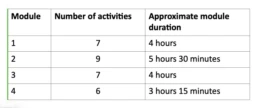
The table below provides information on the number of activities per module and the approximate time required to deliver each module. This does not include breaks. Each activity sheet also includes approximate timings.
Putting the subject matter of the training into practice, a number of the activities in this resource are designed to be led by participants. These provide hands-on opportunities to apply learning and gain experience in engagement/co-productive practice. Briefing materials are included in the resource, to be handed out to participant facilitators in advance of the session to allow time for preparation.
The PEAs in Pods training resource has been licensed under CC BY-NC-ND 4.0.
Individual elements of the training have been licensed as follows:
© Manchester Metropolitan University, licensed under CC BY-NC-ND 4.0, 2025 or
© Noisy Cricket, licensed under CC BY-NC-ND 4.0, 2025
To cite the overall resource
Crockett, K., Nunn, C., Coulman, L. & Linn, S. (2025), PEAs in PODs Community Engagement and Co-Production Training Resource, Manchester Metropolitan University and Noisy Cricket.
Meet our team

Professor of Computational Intelligence in the Department of Computing and Maths at Manchester Metropolitan University




Public Engagement Ambassadors (PEAS): 23 Public Engagement Ambassadors took part in the PEAS in PODS training that underpins the resources we offer here. Eleven PEAs additionally took part in the “learning by doing” through our three Programmes of Public Engagement. These PEAs are: Alex Mbabu (University of Salford), Mustahid Salam (University of Manchester) Cathal O’Reilly (University of Manchester), Matthew Thorpe (MMU), Rochelle Taylor (MMU), John Henry (MMU), Ngozi Nneke (University Academy 92), Femi Stevens (Self Employed) and Shobha Gowda (University of Salford and University of Manchester), Helen Kirby-Hawkins (MMU), Sunday Ekpo (MMU). Project PartnersProf. Andy Miah, Chair in Science Comms & Future Media, Salford UniversityProf. Richard Kingston, Professor of Urban Planning and GISc, Manchester University Project Advisory Prof. David Leslie, Director of Ethics and Responsible Innovation Research at The Alan Turing Institute and Professor of Ethics, Technology and Society at Queen Mary University of LondonEdwin Colyer, Founder and Impact Lead Scientia Scripta
This project has received funding from UKRI engineeringand Physical Sciences Research Council (ESPRC) Grant Ref: EP/W033488/1